here are some sites that have reasonably priced crafty, handmade jewelry and stuff. i'll add more as i find them:
Gifts Define
Junxtaposition
Crafty Ass Chick
Destination Unknown
Bucktooth Mama
Good Morning, Morning
Iglubu
Daisy Janie
Lucky Accessories
Stitch Pixie
ZN Creative Arts
Peggy Li
Invisible Children
Snail Mail Creations
Indie Finds
Cupcake Shop
Indy Collective
One Good Bumblebee
Three Paper Pigs
Sugar Lily
Craft Revolution
Saturday, December 09, 2006
Thursday, December 07, 2006
Wednesday, December 06, 2006
Mason Williams Classical Gas
this is an oldie but it is one of the bestest instrumental songs in the whole world.
while we're on instrumentals, i adore herb alpert and the tijuana brass' "taste of honey."
taste of honey is the last song in the set. the video is enchanting as well. windmills make me nutters. looks like tehachapi?
here's another one of my faves, "this guy's in love with you"
while we're on instrumentals, i adore herb alpert and the tijuana brass' "taste of honey."
taste of honey is the last song in the set. the video is enchanting as well. windmills make me nutters. looks like tehachapi?
here's another one of my faves, "this guy's in love with you"


Lets Say Thanks
i found this at james frey's blog, lets say thanks, postcards for soldiers. you pick a postcard, add a custom message or one of their canned messages (i recommend custom) and send away.
speaking of james frey, he's apparently working on a book. i'm a fan of james' writing despite all the hoopla over his memoir.
speaking of james frey, he's apparently working on a book. i'm a fan of james' writing despite all the hoopla over his memoir.
Monday, December 04, 2006
You Witness News
see a newstory, take photos and send them in to Yahoo and Reuters news service at youwitnessnews. here's the email to submit photos to reuters: pics@reuters.com
of course, there's no pay involved but there's the possibility of getting your photo online or in print for thousands to see.
from the NYT:
read the rest here
of course, there's no pay involved but there's the possibility of getting your photo online or in print for thousands to see.
from the NYT:
Have Camera Phone? Yahoo and Reuters Want You to Work for Their News Service
By SAUL HANSELL
Hoping to turn the millions of people with digital cameras and camera phones into photojournalists, Yahoo and Reuters are introducing a new effort to showcase photographs and video of news events submitted by the public.
Starting tomorrow, the photos and videos submitted will be placed throughout Reuters.com and Yahoo News, the most popular news Web site in the United States, according to comScore MediaMetrix. Reuters said that it would also start to distribute some of the submissions next year to the thousands of print, online and broadcast media outlets that subscribe to its news service. Reuters said it hoped to develop a service devoted entirely to user-submitted photographs and video.
“There is an ongoing demand for interesting and iconic images,” said Chris Ahearn, the president of the Reuters media group. He said the agency had always bought newsworthy pictures from individuals and part-time contributors known as stringers.
“This is looking out and saying, ‘What if everybody in the world were my stringers?’ ” Mr. Ahearn said.
The project is among the most ambitious efforts in what has become known as citizen journalism, attempts by bloggers, start-up local news sites and by global news organizations like CNN and the BBC to see if readers can also become reporters.
Many news organizations turned to photographs taken by amateurs to supplement coverage of events like the London subway bombing and the Asian tsunami. Yahoo’s news division has already used images that were originally posted on Flickr, the company’s photo-sharing site. For example, it created a slide show of images from Thailand after the coup there in September.
read the rest here
Sunday, December 03, 2006
Nathan Dungan
an interesting show on NPR about the divide between what we say about money and greed and how we spend our money. don't know about the malls in your city but they're pretty crowded around these parts this time of year.
americans seem to agree that society has become too materialistic but this christmas, more than not, people will take on more debt to pay for gifts. why?
here's the transcript:
Nathan Dungan talks about the reasons. Mr. Dungan teaches about money through his share-save-spend philosophy.
if you're not christian, you can look past the religious content -- i see myself as a student of all religions -- and see the value of what he says.
read the whole transcript here
americans seem to agree that society has become too materialistic but this christmas, more than not, people will take on more debt to pay for gifts. why?
here's the transcript:
Nathan Dungan talks about the reasons. Mr. Dungan teaches about money through his share-save-spend philosophy.
if you're not christian, you can look past the religious content -- i see myself as a student of all religions -- and see the value of what he says.
Mr. Dungan: And I think this is very appropriate for your question because my grandparents, particularly on my mother’s side, farmers, eastern — southeastern Colorado, raising five children on a 70-acre farm, OK, vegetable farm, they had a very clear definition of needs and wants.
Ms. Tippett: And the difference between needs and wants.
Mr. Dungan: And the difference between needs and wants. They paid cash and they physically had to get in the car to drive into town, you know, to purchase items. And then my grandparents on the other side, I remember my dad telling me stories about in the Depression when he was very young, they had very little food in the house, but yet they still would invite neighbors over to share what they had because that’s just the way it was.
So here we are, there’s kind of the role of the church, I think, is sort of a guiding light in terms of needs of others and gratitude, and really understanding again what is your purpose and place for being on this earth. You know, I think you can’t argue that it’s a good thing that people perhaps have prospered and that more people are homeowners and those kinds of things, but it’s come at a bit of a price as well in terms of the amount of debt that we hold, and from a very young age. I mean, the amount of credit card and, you know, education debt that young people have today is just…
Ms. Tippett: And I think that’s new.
Mr. Dungan: It’s new and it’s…
Ms. Tippett: In the last few years, it’s that college students have credit cards.
Mr. Dungan: Absolutely. I mean, it’s new and it’s debilitating. And I think, in some respects, I believe the church has been complicit in sort of getting sucked into this whole persuasive argument about the role of consumerism in our culture, and I really don’t think they have understood the impact. I believe they are starting to get it, but I don’t think they have fully thought through the impact of what that means for people’s souls, for our, you know, sense of place and time and space, and what it robs of us in terms of just our personal sense of being.
Ms. Tippett: I think that this was in an article you wrote. You asked a pretty condemning question, kind of the bumper sticker question, What would Jesus do?, but it was a version of that. What would Jesus say about churches’ complicity or even just complacence about turning the holiday that is Jesus’ birthday that we’re moving towards, turning that into this consumer fest?
Mr. Dungan: Yes. Well, I think it was in the context, actually, of a sermon that I gave recently at Christ Church Cathedral down in Indianapolis.
Ms. Tippett: And, you know, even though that sounds like a pretty obvious question, it’s not a question I’ve heard anyone ask quite so pointedly.
Mr. Dungan: One of my goals is really to get people to stop and think about where we’re at. You know, there’s the great metaphor about the frog and the boiling pot of water, and that the heat just continues to get turned up but you can’t really tell that it’s getting warmer in the pot, right? The frog can’t. I think, to some degree, that’s our society around consumption. The heat has been turned up, but I don't know that there’s been really a voice of kind of calling the question to say, ‘Is that acceptable; is that OK?’ And so when I put that phrase in the sermon, it was really a call-out to say, ‘Are we thinking about that?’ I mean, if Jesus were in the room today, I think He would be flummoxed by our obsession with consumption. And it doesn’t mean that we haven’t — aren’t still somewhat, to some degree, a generous people, but I do think there’s a point where that is going to be challenging for us to continue to follow through, to be generous when we’re so distracted by the time that we spend.
Jacob Needleman really, I think, focuses a lot on this issue in his book Money and the Meaning of Life, his whole notion about, you know, what is money about, what’s it for, what is the role that it plays in our life. And I think it was in some of his readings that I really started to ponder that.
Robert Wuthnow, a sociologist from Princeton, also asking many of these very same questions. I guess maybe what I’ve tried to do is put the question forth so that people on just a practical day-to-day level start to think about this intersection of money, values, and the culture, you know, and I ask people, are your values really reflected in the choices you’re making with money, or are those values being imposed on you?
read the whole transcript here
Saturday, December 02, 2006

Thursday, November 30, 2006
Red Hot Chili Peppers Book
just published book "Band Together" explores four bands, including the Chilis. cost: $35. release from the publishing company:
Internal Dynamics in U2, REM, Radiohead & The Red Hot Chili Peppers Revealed in New Book
Toronto, November 30, 2006 -- A groundbreaking new book by Canadian author Mirit Eliraz explores the inner mechanics and communal life of the four most popular rock bands in the world.
In Band Together: Internal Dynamics in U2, R.E.M., Radiohead and the Red Hot Chili Peppers (McFarland & Company Publishers, 2006), the members of these iconic groups discuss the long-term collaboration within their respective units. Band Together looks at the relations between the bandmates, their shared artistic vision, their chemistry, the division of labor and proceeds within the group, the roles each member plays, how they cope with collective fame, how they remain united (and what factors test their commitment to each other), how the unit is governed, how the musicians collaborate in the studio, how they interact on tour, and much more.
“If you have ever wondered what it’s like to be part of an enduring and tight-knit rock band, this is the book for you,” says Eliraz.
The book features photos of the bands, as well as an extensive bibliography and detailed index.
McFarland (www.mcfarlandpub.com ) is a leading U.S. publisher of scholarly, reference and academic books that are sold worldwide. The company is recognized for its serious works in a variety of fields, including the performing arts.
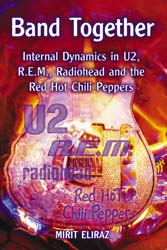
Description
From The Joshua Tree to Blood Sugar Sex Magik, from Automatic for the People to OK Computer, they produced some of the most memorable rock albums of the post-punk era. Beyond the music, though, the members of U2, R.E.M., Radiohead and the Red Hot Chili Peppers share several common bonds. Having emerged from punk’s do-it-yourself ethos, they embody collective creativity over individual artistry. With the exception of the Chili Peppers’ revolving-door guitarists, each band’s lineup has remained stable while the groups outlasted most of their contemporaries. The twin factors of group-inspired music and long-term collaboration make these four bands important case studies in modern rock and roll.
With a focus on internal creative dynamics, author Mirit Eliraz studies four of the most popular, critically acclaimed, and prolific rock bands of the last quarter century. Introductory chapters offer band bios; reasons for formation; and each group’s friends, collaborators and business partners. Middle chapters discuss the governing structures and general relations within the bands; obstacles to unity and survival; how diverse elements are merged into a productive whole; role divisions; the collaborative process; and life on the road. Concluding chapters cover external influences on band dynamics; the evolution of each band’s communal life; and challenges to the band paradigm.
author's email: bandtogetherbook@gmail.com
Happy Together
utah musicans Seve vs. Evan cover of the Turtles classic... Happy Together. i adore this song. their other stuff is pretty cool too.
Wednesday, November 29, 2006
Hi I'm Adam From Africa
geneticist Spencer Wells traced human DNA back to its origins and discovered that every human, no matter what we look like, descended from people in Africa. science and religion are always battling it out but here's the ironic thing, science unites humans but religion divides us. race always divides us too but we all are descendants of a black man, separated by 2,000 generations, according to Wells.
Wells, by taking blood samples and studying DNA, proved that the Native Americans started with as few as 10 very hearty Chukchi people-- they live in 30 below weather in Russia with reindeer-- who crossed the Bering Strait about 15,000 years ago are the ancestors of every Native American. He traced the Chukchi people to a family in Kazakhstan. he traced the Kazakhstan people from Africa.
here is the question answered:
spencer traces the journey of man in his book, "Journey of Man: A Genetic Odyssey."
here's the whole darned interview because i think it's fascinating:
Wells, by taking blood samples and studying DNA, proved that the Native Americans started with as few as 10 very hearty Chukchi people-- they live in 30 below weather in Russia with reindeer-- who crossed the Bering Strait about 15,000 years ago are the ancestors of every Native American. He traced the Chukchi people to a family in Kazakhstan. he traced the Kazakhstan people from Africa.
here is the question answered:
Where did Adam (the original male) live and what did he look like?
The unequivocal answer is that he lived in Africa. Every piece of DNA in our bodies can be traced back to an African source. The Y-chromosome traces back to eastern or southern Africa, around 60,000 years ago. The present-day inhabitants of Ethiopia, Sudan and southern Africa carry the clearest signals of our earliest ancestry, signals that have been lost in the rest of us. So they give us a glimpse of our 60,000 year-old Adam. Adam would have been fully modern, both in terms of his appearance and his brain function. It is speculation, of course, but perhaps the San Bushmen of the Kalahari - who in many ways are a composite model of facial features from people all over the world - give us a portrait of Adam and his fellow early humans.
spencer traces the journey of man in his book, "Journey of Man: A Genetic Odyssey."
here's the whole darned interview because i think it's fascinating:
AN INTERVIEW WITH SPENCER WELLS
Geneticist Spencer Wells spends his life traveling the globe taking blood samples from men and women in order to unravel the secrets of the human story: Where did humans come from? How did they spread over the globe? How did different races evolve? In THE JOURNEY OF MAN: A GENETIC ODYSSEY (Princeton University Press), Wells answers those questions for the first time using the latest discoveries of human genetics. We talked to Spencer as he sat for a moment between trips to Lebanon and Tunisia:
You say that there really was an Adam--a common male ancestor for all humans. How did you find that out?
We study a historical document carried in the blood of everyone alive today - DNA. Tiny spelling mistakes - changes in the DNA sequence - that occurred in the past can give us clues about genealogical relationships. If two people share a change, then they are likely to share an ancestor. If we look at the spelling mistakes carried by people all over the world, we find that ultimately all of us share a common ancestor. In the case of the male line, defined by a piece of DNA known as the Y-chromosome, this analysis allows us to trace back to a common male ancestor for everyone alive today. In other words, Adam.
Where did Adam live and what did he look like?
The unequivocal answer is that he lived in Africa. Every piece of DNA in our bodies can be traced back to an African source. The Y-chromosome traces back to eastern or southern Africa, around 60,000 years ago. The present-day inhabitants of Ethiopia, Sudan and southern Africa carry the clearest signals of our earliest ancestry, signals that have been lost in the rest of us. So they give us a glimpse of our 60,000 year-old Adam. Adam would have been fully modern, both in terms of his appearance and his brain function. It is speculation, of course, but perhaps the San Bushmen of the Kalahari - who in many ways are a composite model of facial features from people all over the world - give us a portrait of Adam and his fellow early humans.
Why do you focus on men? What about Eve?
It turns out that the Y-chromosome gives us two very important clues to the question of how we populated the world. First, it shows us our most recent common ancestor (Adam). This man lived in Africa around 60,000 years ago. The significance of this date is that it means that all modern humans were living in Africa until at least that time. In other words, within the past 60,000 years - only about 2,000 generations - our species has populated the entire planet. Clearly, we are all very closely related. The second clue provided by the Y-chromosome concerns the routes we followed in our migrations around the planet. Due to something I describe in the book as 'sexual politics', the male line gives us the best view of the routes followed. So, the Y - a piece of DNA that really doesn't do much more than to make men men - is one of the best historical documents ever written. Women also have a female history written in their mitochondrial DNA, showing the path to Eve around 150,000 years ago. For reasons explored in the book, the mitochondrial signal turns out to provide less resolution for studies of population history than the Y. Again, it comes down to a long history of sexual politics.
How does the genetic Adam relate to the Adam of the bible?
It's interesting that both genetics and the Bible show that there is a common origin of humanity. According to genetic data we come from a single male ancestor. In the Bible too it is mentioned that there is a single male Adam and single female, Eve. I don't equate our results one-to-one with the biblical story, of course, because if you count back through the generations described in the Bible, Adam should have existed in 4004 BC, and our Adam existed 60,000 years ago. Also, our Adam and Eve weren't the only people alive at the time, just the lucky ones who left descendants down to the present day. But it is nice to know that we arrive at the same general conclusion: we're all related.
If we all came from a black man, how did men and women of different colors come into being?
The accepted explanation for skin color differences is that we first evolved in a tropical region, in Africa. The tropical sun is quite strong, so the skin needed the protection provided by the natural sunscreen, melanin, which makes skin dark. When we started moving into the Northern Hemisphere 40,000 years ago, the sun was not as strong. Anyone who's been to London in February can tell you that! And because the sun helps us to synthesize Vitamin D, which we need to grow strong bones, we had to lose some of our pigmentation to allow enough sunlight through.
So what do our genes tell us about the biological differences between, say, Europeans and Africans?
They are literally only skin deep. We are all African cousins separated by - at most - 2,000 generations.
Has research on genes told us something about the first people to arrive in America?
Yes. Our data tells us that we could not have been in the Americas prior to 20,000 years ago, and the most likely date of entry was around 15,000 years ago. This is because the oldest Y-chromosome lineage in the Americas originated in Central Asia 15,000-20,000 years ago, and then migrated to the northeast, across the Bering Strait. If we were still in Central Asia 20,000 years ago, we couldn't have been in the Americas until after that date.
How do other scientists and the public react to your research?
In general, there is more and more agreement among paleoanthropologists, archaeologists, geneticists and historians about the details of our past. I suppose one thing that some people still find hard to accept is that we left Africa so recently, and blitzed our way around the world, but it does seem to have happened like that. I urge them to read the book, where I discuss the archaeological, linguistic and climatological clues that fill in the details of our journey. It is a synthetic look at the past, not simply a genetic tale.
Tuesday, November 28, 2006
Heroes Tim Sale
by way of galley cat, an interview with the comic book artist behind my new favorite show, NBC's Heroes.
vote heroes best new TV drama
Hiro's blog

Mikah Sykes
an interesting interview with the portland, oregon musician who is a friend of john frusciante's girlfriend, emily kokal. he talks about his experience recording in john's home. i checked out mikah's myspace and i didn't really like his music much but apparently, john does and perhaps you will.
i do like this though.
i do like this though.
Friday, November 24, 2006
Chili Peppers Roundhouse London
one of the best reviews of a chili show that i've ever seen and some awesome pics. this was a show at the roundhouse in london the day before thanksgiving. john truly does look troubled -- no turkey with loved ones? i imagine being on tour is a bear at times. Here's some more fabulous pics.
here is short video of what looks to be an exhausted or bothered john.
here is short video of what looks to be an exhausted or bothered john.
Tuesday, November 21, 2006
John Frusciante's Sleeping
okay, so i stuck around cause the chili peppers were gonna be on the American Music Awards. welp, there they are in london by satellite, winning the favorite pop rock/band/duo category and anthony says John is back at the room sleeping. ugh.
funny stuff. oh well. rest up dear johnny!
oh, and i forgot, john must be resting up for the show ms. flo is going to see tomorrow in london. have a blast!
a link to the roxy show video that i *didn't* win tickets to :-(
some roxy show photos
Brandy
funny stuff. oh well. rest up dear johnny!
oh, and i forgot, john must be resting up for the show ms. flo is going to see tomorrow in london. have a blast!
a link to the roxy show video that i *didn't* win tickets to :-(
some roxy show photos
Brandy
Monday, November 20, 2006
It's a John Frusciante Evening!
Fox on the Run
gorgeous Murderers from To Record Water for Only 10 Days
gorgeous Murderers from To Record Water for Only 10 Days
Ode to John
Frusciante, that is....
this is way fab from a crafty gal across the pond.
here's another tribute set to "song to sing when i'm lonely." the ultimate happy song.
this is way fab from a crafty gal across the pond.
here's another tribute set to "song to sing when i'm lonely." the ultimate happy song.
Save the Cheerleader

save the world.... does anybody watch Heroes? this show is the best, but i've heard zero buzz. i hope it doesn't get cancelled. it's about ordinary people with extraordinary powers. a cheerleader who can heal her body, a cop who can read minds, the heroin addicted painter who paints the future. one of the funniest characters, hiro, who's from japan, can travel through time. they're all getting around to meeting each other. who knows what they're supposed to do but we've been led to believe that they are going to save the world from some doomsday.
but there are bad guys with super powers. sylar and the the evil politician who can fly. just what the world needs. Ha!
there are others who may be good or bad. we don't know yet.
it's a large cast of mostly unknown actors as far as i can tell.
it all kind of takes place within a graphic novel. watch it! you'll be hooked.
God's Gonna Cut You Down
Chili Peppers appear on the new video for the Man in Black's song off American V
Evanescence singer Amy Lee, Coldplay's Chris Martin, U2 vocalist Bono and Plus 44 drummer Travis Barker, along with Flea and Anthony Kiedis of the Red Hot Chili Peppers, all appear in the new video for the Johnny Cash song "God's Gonna Cut You Down." The concept and video treatment for the clip came from Justin Timberlake, who also appears in the video. A total of 36 artists show up in the clip, including Iggy Pop, Kanye West, actor Terrence Howard, Chris Rock, Jay-Z, Kate Moss, Sheryl Crow, Tommy Lee, the Dixie Chicks, Keith Richards, Kid Rock, Johnny Depp and many others.
The video features each artist in a separate vignette as they reflect silently on hearing the song for the first time. The video was directed by Tony Kaye, who recently helmed the clip for the Red Hot Chili Peppers' "Dani California."
The first choice to direct was Mark Romanek, who handled the video for Cash's celebrated cover of Nine Inch Nails' "Hurt," but scheduling conflicts forced him to bow out.
The video was shot in Los Angeles, New York and London, with Richards' sequence filmed in Amsterdam.
The song comes from the latest Cash release, American V: A Hundred Highways, which the musical legend recorded shortly before his death in 2003 at the age of 71.
Sunday, November 19, 2006
Blood Diamond
bling is dead?
the movie "blood diamond" out dec. 8 shines a light on the sparkly jewel and the bloody ways it's used to fund organizations such as al quaida and african war lords.
"in america it's bling bling. out here it's bling bang," says leo dicaprio in the movie trailer.
but hold on, it's only so-called "conflict diamonds" that are the trouble, estimated to be less than 1% of the diamonds sold.
the movie "blood diamond" out dec. 8 shines a light on the sparkly jewel and the bloody ways it's used to fund organizations such as al quaida and african war lords.
"in america it's bling bling. out here it's bling bang," says leo dicaprio in the movie trailer.
but hold on, it's only so-called "conflict diamonds" that are the trouble, estimated to be less than 1% of the diamonds sold.
Friday, November 10, 2006
Who's Rumsfeld?
from the guys doing the work:
that dose of reality thanks to a new york times story today.
"Rumsfeld’s out," he said to five marines sprawled with rifles on the cold floor.
Lance Cpl. James L. Davis Jr. looked up from his cigarette. "Who’s Rumsfeld?" he asked.
that dose of reality thanks to a new york times story today.
Subscribe to:
Posts (Atom)